


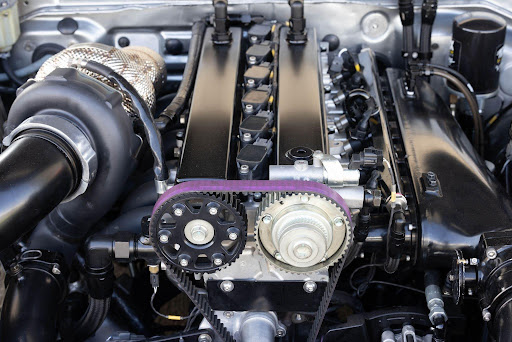
The numbers caught a lot of people off guard. Used Japanese engines crossing into North America jumped sharply through the 2010s and early 2020s, and the pace hasn’t really slowed. Industry trackers and import brokers put the annual count of JDM engine units arriving on US soil somewhere well into the six figures, far more than most casual observers realize. Behind those shipments sits a tight loop of Japanese auction houses, container freight networks, and a steadily growing customer base of independent shops and serious DIY builders.
Anyone who has worked under the hood of a 1990s or 2000s Japanese platform knows the math. Domestic-market motors in those cars get tired somewhere around the 200,000-mile mark. Replacing one with another high-mileage US engine means taking on the same problem with less life left in it. A clean import unit pulled from a Japanese vehicle that spent its entire life under shaken inspection is a fundamentally different proposition.
The economics of low-mileage imports
Japan’s vehicle inspection system, called shaken, gets stricter the older a car becomes. Once a vehicle hits roughly 13 years, the inspection costs and tax penalties make keeping it on the road in Japan financially painful. That’s why running cars get scrapped at mileage figures American owners would consider barely broken in. Dismantlers pull the drivetrains, list them at one of the major Japanese auction houses, and the units end up in containers bound for ports in Long Beach, Vancouver, or Newark within a few weeks.
The result is a US-side inventory that consistently sits in the 50,000 to 65,000-mile range. For an importer like JDM Engines Direct, that mileage band functions as a floor. Anything higher gets passed over because it doesn’t deliver the durability customers now expect. That standard didn’t exist in this segment ten years ago. Buyers used to take whatever showed up. Now they expect documentation, photos of compression numbers, and a warranty period that actually holds up to a claim.
That shift in buyer expectations has changed who survives in the import business. Operators running on the old “as-is, no claims” model have quietly disappeared. The ones still around have invested in inspection bays, run-stand testing, and customer service infrastructure that more closely resembles what a domestic parts distributor would offer.
Pricing has also flattened in ways that surprise people who haven’t bought in a few years. The wild swings driven by container shortages and yen-dollar volatility have settled into a tighter range. A clean SR20DET sits within a predictable window. So does a 1JZ-GTE. Buyers used to gamble on import timing the way day traders gamble on a chart. That window of opportunism has mostly closed.
Why specific platforms keep driving demand
Demand isn’t spread evenly across every Japanese model. A handful of platforms do most of the lifting, and the math behind why is straightforward.
Toyota’s 2JZ-GTE remains the headline act. The twin-turbo straight-six has held its valuation longer than any aftermarket-adjacent part should reasonably hold value, and units pulled from JZA80 Supras and Aristos still command premiums well above what a comparable American motor would fetch. Right behind it sit the 1JZ-GTE and the naturally aspirated 1JZ-GE, both of which power Mark II, Chaser, and Cresta builds across North America.
Nissan’s catalogue does similar work. The SR20DET pulled from S13, S14, and S15 Silvia chassis has been a drift-build staple for two solid decades. RB-series engines from R32, R33, and R34 Skylines clear the 25-year EPA import threshold one model year at a time, which keeps interest fresh as new chassis become legal. Then there’s the slow-burn category: K20A and K24A units from Honda Civic Type R and Accord Euro R, EJ207 boxers pulled from STI Type RA imports, and the 4G63T from Mitsubishi Lancer Evolution platforms.
Each of those engines has a real community behind it. Forums, YouTube channels, and dedicated build threads keep the knowledge base alive. When Hoonigan or Donut Media puts a JDM swap on camera, the parts ecosystem around it gets another lift.
The 25-year rule and what it does to the market
The federal 25-year import rule changes the supply picture every January. Vehicles built 25 model years ago become legal for full import without DOT and EPA modification. This year, the rolling clock cleared a fresh batch of model-year 2001 builds. Next January, 2002 cars will follow. That continuous expansion keeps the Skyline GT-R pipeline open for R34 chassis, the RX-7 supply stable for late FD3S, and the Silvia supply alive through final S15 production.
Engine importers have been working around this clock the entire time. Engines themselves don’t fall under the same vehicle import restrictions in most states, which is why JDM motor stock has always moved more freely than complete vehicles ever did. But when entire cars become legal, demand for their drivetrains spikes. Replacement parts for legally imported R34s have to come from somewhere, and the supply chain for those parts has been anticipated for years.
Where the market goes from here
A few trends are visible if you watch auction data and shipping volumes.
Hybrid and modern platforms are coming online. Engines from 2010s-era Lexus hybrids, late-model Highlanders, and current-generation Subarus are showing up at Japanese auctions in real volume now. Importers are starting to stock these alongside the classic-era inventory, and US shops are buying them for collision repairs and high-mileage replacements where new OEM parts cost more than the customer wants to spend. Insurance adjusters have caught onto the math too, which is why JDM units increasingly appear on repair estimates from body shops that want to keep total claims under threshold.
Container freight costs have stabilized after the 2021 and 2022 chaos, which has tightened margins in a way that pushes the lower-quality importers out. The remaining players have invested in proper warranty infrastructure, financing options, and direct shipping to professional installers across the country. A few have built relationships with specific Japanese dismantlers that prioritize their orders, which means inventory turnover happens fast enough that a buyer can find a rare unit one week and have it stateside the next.
What this segment looks like five years from now will depend on a few variables. Japanese auction supply, the trajectory of EV adoption affecting US demand for ICE replacement, and whether enthusiast platforms keep generating fresh interest will all play a role. But the core dynamic isn’t going anywhere. A 60,000-mile engine pulled from a Japanese car at scrapyard prices, shipped to North America, and sold with a working warranty will keep beating the alternatives on cost per remaining service mile. That math is what built the industry, and it’s what keeps it expanding.
